



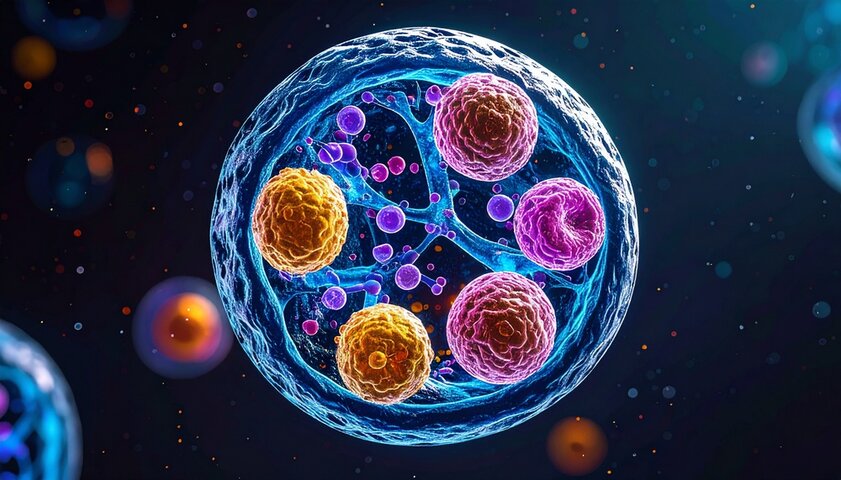
Biomedical researchers at Texas A&M University report that they may have found a way to halt or even reverse the loss of cellular energy associated with damage and aging. If future studies confirm the results, this discovery could lead to significant changes in the treatment of many diseases in medicine.
A Decline in Mitochondria can Weaken Cells
Mitochondria are small but extremely important components of almost all body cells and are often referred to as the “powerhouses of the cell”. They generate most of the energy the body needs by converting the breakdown of nutrients into the universal energy currency ATP. In addition to this central task, they also play an important role in metabolism, for example in the breakdown of fatty acids, and can even produce heat if required. Mitochondria have their own, exclusively maternally inherited DNA, which indicates that they originally emerged from independent bacteria. They are also involved in the control of programmed cell death, a mechanism that is important for removing damaged or dangerous cells. A healthy lifestyle with exercise, a balanced diet, good sleep and little stress supports their performance.

As human cells age or are damaged by degenerative diseases such as Alzheimer’s or by harmful influences such as chemotherapy drugs, their ability to produce energy steadily declines. One of the main reasons for this is the decreasing number of mitochondria, which supply most of the energy used by a cell. Whether in brain tissue, heart muscle or other organs, a decline in mitochondria leads to weaker, less healthy cells that are ultimately no longer able to perform their essential functions.
Dr. Akhilesh K. Gaharwar and PhD student John Soukar, together with colleagues from the Department of Biomedical Engineering, have developed a technique to replenish damaged cells with fresh mitochondria. By replenishing these tiny energy producers, the method can restore energy production to previous levels and significantly improve the overall health of cells. Mitochondrial decline has been linked to aging, heart disease and various neurodegenerative diseases. A strategy that boosts the body’s natural ability to replace worn-out mitochondria could, in principle, help address all of these problems at once.
Nanoflowers Transform Stem Cells into Mitochondrial Donors
The study, published in the Proceedings of the National Academy of Sciences, combined microscopic, flower-shaped particles called nanoflowers with stem cells. When the stem cells were exposed to these nanoflowers, they began to produce about twice as many mitochondria as usual. When the strengthened stem cells were then placed next to damaged or aging cells, they passed on their extra mitochondria to these neighboring, damaged cells. Once they were supplied with new mitochondria, the previously damaged cells were able to restore their energy production and normal activity. These revitalized cells not only showed improved energy levels, but also became more resistant to cell death, even when later exposed to harmful treatments such as chemotherapy.
“We trained healthy cells to share their spare batteries with weaker ones,” said Gaharwar, professor of biomedical engineering. “By increasing the number of mitochondria in the donor cells, we can help aging or damaged cells regain their vitality – without genetic modification or drugs.” Although cells are naturally capable of exchanging small amounts of mitochondria, the stem cells treated with Nanoflowers, which the team refers to as mitochondrial biofactories, transferred two to four times more mitochondria than untreated stem cells. “The multiple increase in efficiency exceeded our expectations,” said Soukar, lead author of the study. “It’s like putting a new battery in an old electrical appliance. Instead of throwing them away, we put fully charged batteries from healthy cells into diseased cells.”
Longer Duration of Effect of Mitochondrial Therapies
Researchers have tried other ways to increase the number of mitochondria in cells, but these approaches often come with trade-offs. Drug-based methods rely on small molecules that leave the cells relatively quickly, so patients may need frequent and repeated treatments to maintain the effect. In contrast, the larger nanoparticles (around 100 nanometers in diameter) remain in the cell and continue to stimulate mitochondrial production more effectively. As a result, therapies based on this nanoflower technology may only need to be administered about once a month. “This is an early but exciting step towards regenerating aging tissues using their own biological mechanisms,” said Gaharwar. “If we can safely strengthen this natural system of energy distribution, it could one day help slow or even reverse some of the effects of cellular aging.”
The nanoflowers are made from molybdenum disulfide, an inorganic compound that can form many different two-dimensional shapes on a very small scale. The Gaharwar lab is one of a small group of research groups investigating how molybdenum disulphide could be used for biomedical purposes. Stem cells already play a central role in cutting-edge research into tissue repair and regeneration. Using nanoflowers to enhance the performance of stem cells could be an important step in making these cells even more effective in future therapies.
Versatile Approach for Numerous Tissues
One of the most promising aspects of this technique is its flexibility. Although the method is still at an early stage and requires much more testing, it could theoretically be used to treat loss of function in many different tissues throughout the body. “You could put the cells anywhere in the patient’s body,” Soukar said. “So for cardiomyopathy, you could treat the heart cells directly by putting the stem cells directly in or near the heart.” Cardiomyopathy is a collective term for diseases of the heart muscle in which the structure or function of the heart muscle is disturbed. As a result, the heart can no longer pump blood as well or cannot relax properly.

Muscular dystrophy is a generic term for a group of hereditary muscle diseases in which the muscles gradually become weaker and break down. This is caused by changes (mutations) in genes that are important for the development or stability of muscle cells. As a result, the muscle cells are no longer able to maintain their normal function and eventually die. According to the researchers, stem cells can be injected directly into the muscle to treat muscular dystrophy. The method is extremely promising as it can be used for a variety of cases. The new findings could lead to new treatment methods for various diseases.
Neuroscientists Discover Immune Cells that Could Slow Down the Ageing Process
Other researchers have identified a new group of T helper cells that appear to protect against ageing by eliminating harmful senescent cells. Their presence in supercentenarians suggests they may be key to maintaining a healthier, age-appropriate immune system.
Prof. Alon Monsonego of Ben-Gurion University of the Negev has found that T helper lymphocytes, immune cells involved in regulating the body’s defenses, change function with age. These changes may reflect a person’s biological age, which may not correspond to their chronological age. As part of these changes, the research team (the labs of Prof. Monsonego and Prof. Esti Yeger-Lotem) identified a previously unknown group of T helper cells that become more abundant with age. The significance of this discovery became clearer when a Japanese study of supercentenarians, people who are well over 100 years old, found that the same subset of T helper cells were abundant in their immune systems. Prof. Monsonego believes that these cells may help maintain an appropriate immune response for a person’s stage of life. The findings were recently published in Nature Aging.
A Special Subset of T Helper Cells Could Hold the Secret to a Healthier and Longer Life
Scientists describe aging as a process in which cells gradually lose the ability to repair routine damage. When this happens, the body shows signs of ageing. Senescent cells, which occur naturally when properly regulated, become harmful when they accumulate, as they can trigger inflammation and tissue damage. The researchers discovered that some of the T helper cells, whose numbers increase unexpectedly with age, have lethal capabilities. These cells help to remove senescent cells and thus limit their negative effects. Prof. Monsonego’s work showed that a reduction in the number of these T helper cells in mice led to faster ageing of the animals and a shortening of their lifespan. This unusual and highly specialized subset of T helper cells continues to increase with age and appears to play an important role in slowing the aging process.

Since T helper cells change with age and appear to play a central role in the aging process, Prof. Monosonego and his team propose to monitor these immune patterns in people aged 30 and older. Such tracking could provide insight into how quickly someone is ageing biologically and help to take early action to support healthy ageing. Differences of several decades can develop between biological and chronological age.
“It is said that to reverse and “rejuvenate” the ageing process, we need to reset the immune system to the state of people in their 20s. However, our research shows that this may not be the case. People do not need an overloaded immune system, but one that functions properly and is appropriate for their stage of life. Therefore, one of the ‘basic assumptions’ about slowing down the aging process may be wrong,” says Prof. Monsonego. The newly identified cells not only offer new insights into the ageing process, but could also be useful for the diagnosis and future treatments of dysregulated ageing, longevity and age-related diseases.