



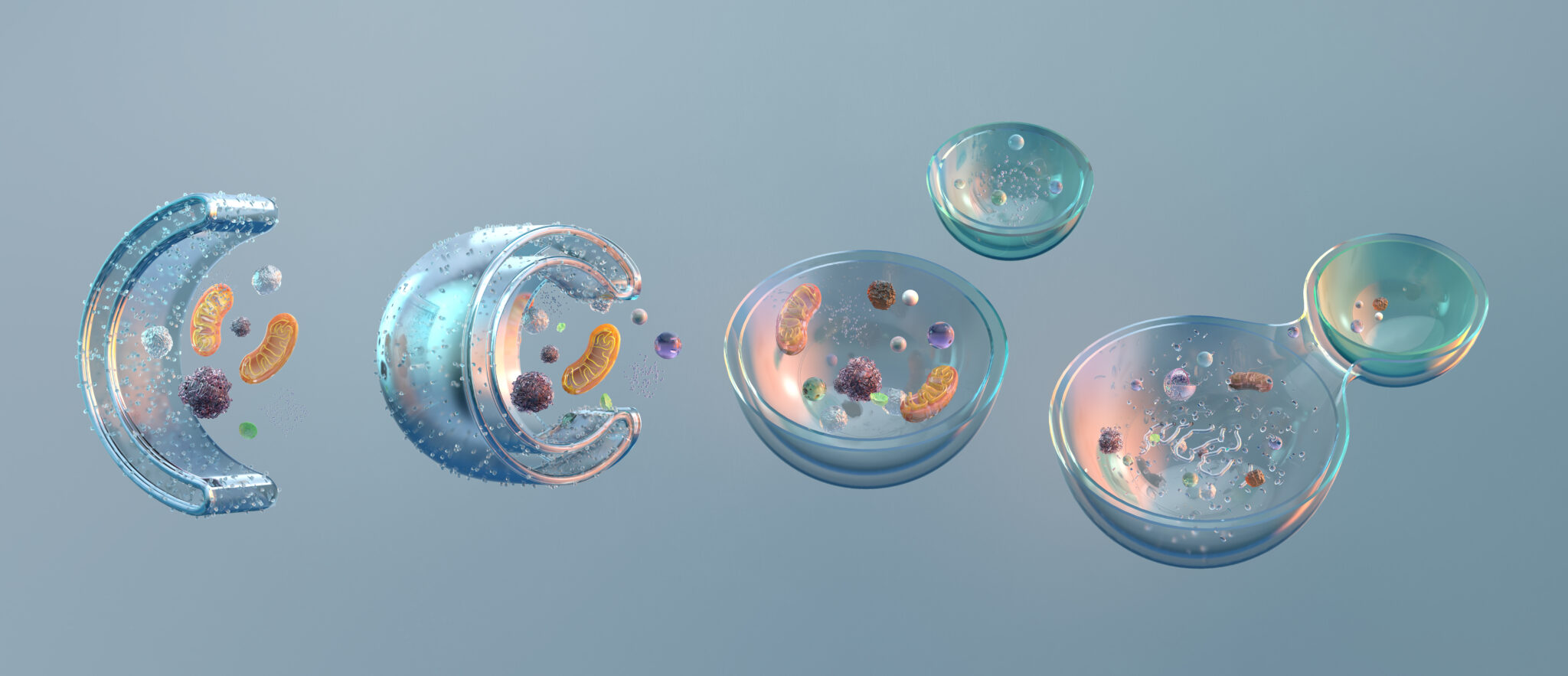
Our bodies rely on a multitude of finely tuned processes that ensure cells perform their functions reliably. During normal metabolism, damaged proteins, defective cellular componFüge eine Übersetzung in Français hinzuents, and other waste products are constantly produced. If these residues are not adequately removed, they can accumulate and impair cellular function. To prevent this from happening, the body has a biological recycling system: autophagy.
Autophagy: A Complex Process
The term comes from Greek and literally means “self-digestion.” Behind this lies a fascinating process in which the cell recognizes components that are no longer needed or are damaged, encloses them in special structures, and then breaks them down.
The molecular building blocks recovered in this process become available to the cell once again. They can be used, for example, to produce new proteins or other vital components. Autophagy thus serves not only to eliminate waste but also to recycle valuable resources. This process is of great importance for cellular health. It supports adaptation to changing conditions and helps limit harmful buildup. Disruptions in autophagy are associated with various diseases, including neurodegenerative disorders, diabetes, cardiovascular diseases, and cancer. It is no wonder, then, that autophagy has been one of the key areas of research on healthy aging for years. Scientists are investigating whether this mechanism can be specifically influenced to understand age-related changes and, in the long term, develop new therapeutic approaches.
Does the Body Lose its Ability to Cleanse its Cells as it Ages?
A common belief in aging research is that autophagy becomes increasingly less effective over the course of a lifetime. According to this view, cells may become less efficient at removing damaged components as they age. The result would be a greater accumulation of cellular waste, which could contribute to the development of age-related functional impairments. This assumption is biologically plausible. However, the evidence in humans is less clear-cut than is often assumed.
This is precisely where a study by scientists at the Sanford Burnham Prebys Medical Discovery Institute comes in. The research team sought to determine how autophagy actually changes with age in healthy people. The researchers were interested not only in potential age-related differences but also in whether different cell types and genders exhibit distinct patterns. The results were published in the journal *Aging Cell *. They challenge the notion that cellular self-cleansing follows a uniform downward trend throughout the body.
Instead, the study suggests that the development of autophagy must be viewed in a much more nuanced way. Some cells show reduced recycling activity with age, others change very little, and still others exhibit increased activity. This brings a crucial question to the forefront: Is biological aging actually associated with a general loss of cellular cleanup, or do the processes change in different ways depending on the tissue and individual characteristics?
A Comparison of Blood, Skin, and Nerve Cells
To investigate this question, the researchers examined blood and skin samples from volunteer participants aged 23 to 72. According to their own reports, the participants did not suffer from any chronic diseases. A unique aspect of the study was that the team did not limit themselves to the samples originally collected. From a portion of the skin cells, the scientists generated what are known as induced neurons. These are cells reprogrammed in the laboratory to exhibit the characteristics of nerve cells. In this way, the researchers were able to study autophagy in three different cell types: blood cells, skin cells, and induced neurons.
This comparison is important because cells in the body perform very different tasks. Skin cells are involved in the formation and renewal of the skin, while nerve cells specialize in processing and transmitting information. Blood cells, in turn, are responsible for tasks such as transporting substances and supporting the immune system. Although all these cells rely on fundamental quality control mechanisms, their biological requirements are not necessarily identical. Therefore, it would be problematic to draw conclusions about processes throughout the entire organism based on measurements from just one cell type. The study aimed to highlight precisely these differences and provide a more accurate picture of how cellular recycling evolves during aging.
Why the Activity of Individual Genes is Not Sufficient
The scientists first analyzed RNA transcripts. These molecules are produced when genetic information is transcribed from DNA to control the production of proteins and other cellular components. Using this data, the researchers were able to examine how the activity of genes involved in autophagy changes. However, analyzing gene activity alone would have captured only a portion of the biological processes.
This is because there is an important distinction between a gene’s activity and the actual course of a cellular process. A cell can express certain genes more or less strongly without the speed of the underlying process changing accordingly. It is also crucial which proteins are actually present, how they are regulated, and how quickly the structures involved function.
For this reason, the researchers also measured what is known as the “autophagy flux.” This describes the intensity with which material is transported through and broken down by the recycling process. The combination of both methods provided a more nuanced view of cellular activity. It turned out that the amount of autophagy-related RNA transcripts did not allow for a reliable conclusion about how intensively the recycling actually took place. For researchers, this means that anyone who wants to understand autophagy should not rely solely on the activity of individual genes. Direct measurements of the biological process are crucial for assessing the actual function of cellular self-cleaning. This finding could also be important for future studies investigating how medications, diet, exercise, or other factors alter autophagy.
Gender and Cell Type Influence the Aging Process
The results showed clear differences between the groups studied. The changes in skin cells were particularly striking. In male participants, autophagy activity in skin cells decreased with age. In female participants, however, it remained comparatively stable. A different pattern emerged in the induced neurons derived from the skin cells of female participants. In these cells, recycling activity increased with age.
These observations suggest that autophagy is not regulated according to the same biological pattern everywhere. Aging processes may differ depending on cell type and may also be influenced by sex-specific biological factors. It is important to interpret the results correctly: The study does not allow for generalizations about all skin or nerve cells in men and women. Rather, it reveals differences within the samples and groups studied.
Furthermore, the higher activity in the induced neurons does not directly imply that nerve cells in the living human brain generally undergo more autophagy as they age. While the cells generated in the laboratory provide important insights, they do not fully replicate the conditions found in the human body.
Despite these limitations, the study provides an important insight: biological aging is not a uniform process that affects all cells equally. Rather, different bodily functions change in different ways.
When Increased Cell Recycling Is Linked to Poorer Fitness
The findings regarding the link between autophagy and physical performance were particularly surprising. The research team investigated whether the measured recycling activity was associated with various indicators of health and fitness. This revealed an unexpected pattern among participants aged 70 and older: Higher autophagy activity was associated with poorer scores on certain measures of physical function in all three cell types studied. In blood cells, higher recycling activity was associated with lower aerobic fitness. Simply put, this describes how well the body can take up and utilize oxygen during physical exertion.

In skin cells, a correlation was observed between higher autophagy activity and a higher body mass index (BMI). This measure relates body weight to height; however, on its own, it does not allow for a complete assessment of health status. In the induced neurons, the researchers found associations with lower grip strength, a lower metabolic rate, and a higher resting heart rate.
At first glance, these results seem contradictory. After all, autophagy is considered a protective mechanism that removes damaged cellular components and supports cell function. Why, then, would higher activity be associated with less favorable health characteristics? The answer remains unclear. One possible explanation is that, under certain conditions, increased recycling activity represents a response to other cellular stresses. It could, for example, be related to an increased need for cellular cleanup. However, the present findings do not prove that this is, in fact, the reason for the observed associations.
Nor does the study prove that increased autophagy impairs physical fitness. These are statistical correlations from which no clear cause-and-effect relationship can be inferred. Nevertheless, the results illustrate that the activity of a biological defense mechanism should not be evaluated in isolation. What matters is the context in which it occurs and its significance for the respective cell and the organism as a whole.
Is Maximizing Autophagy Even the Goal?
The new study raises a fundamental question for research on healthy aging: Should autophagy generally be increased, or might it make more sense to regulate its activity to the right degree? In the public discourse on cellular health, autophagy is often portrayed as a process that should be activated as strongly as possible. This easily gives the impression that more cellular recycling must automatically lead to better health and slower aging.
The research findings suggest that this notion should be viewed critically. Autophagy performs important functions, but its activity is part of a complex biological network. A single measurement alone does not necessarily indicate whether a cell is healthy or under stress. The timing, cell type, and age can also be crucial for interpretation.
Higher recycling activity could, in one situation, help eliminate damaged components more efficiently. In another situation, it could be associated with altered metabolic conditions or other stresses. Whether a change is beneficial cannot therefore be assessed solely based on the level of measured autophagy. For the development of future therapies, this means that a blanket increase in the process might not be sufficient. First, it must be clarified more precisely which changes are beneficial in which cells and how they relate to a person’s actual health.
Can Gentle Exercise Influence Cellular Activity?
In addition to age-related differences, the scientists investigated whether physical activity might be associated with changes in autophagy. To this end, they conducted a small pilot study with five participants aged between 77 and 88. The participants completed a program of gentle exercise over a period of twelve weeks. The focus was on activities designed to reduce the risk of falls. Before the program began and after it ended, the researchers collected blood samples to measure autophagy activity in the blood cells.
The preliminary results were encouraging. After the exercise program, the measured recycling activity in the blood cells decreased toward a level more commonly observed in younger adults. At the same time, the participants’ physical performance improved. This pilot study thus opens up an interesting prospect: Physical activity may not only influence muscles, balance, and endurance, but may also be associated with changes in fundamental cellular processes.
However, the number of participants is very small. With only five people, it is not possible to reliably determine whether the observed changes would also occur in other older adults. Furthermore, it remains unclear whether the changes in autophagy directly contributed to the improvements in physical performance. The results should therefore be interpreted as initial indications, not as proof of a specific effect of exercise on cellular self-cleansing.
The form of exercise studied was designed for older adults and focused on reducing the risk of falls. This makes the findings particularly interesting for addressing the question of how physical activity can be meaningfully integrated into daily life even in old age. As people age, muscle strength, balance, and endurance can decline. Exercise programs designed to address these abilities can therefore play an important role in maintaining independence.
Whether such programs can also specifically regulate autophagy requires further investigation. The current pilot study provides a starting point for this, but does not establish a basis for claiming that a specific form of exercise can reverse cellular aging or rejuvenate biological age. It is conceivable that physical activity influences various processes in the body simultaneously. To determine the role of autophagy in these processes, larger studies would need to systematically track both cellular changes and physical outcomes. The crucial question, therefore, is not merely whether exercise alters recycling activity. Scientists must also investigate which changes are associated with better health in the long term.
What Implications Do these Findings Have for Future Therapies?
The findings could be significant for the development of new approaches to support healthy aging. There is great interest in autophagy because the process is involved in maintaining cellular health and is associated with various diseases. A review article published in 2026 in the *Journal of Molecular Biology* also highlights the connections between autophagy and healthy aging and underscores the importance of further research into the underlying mechanisms. If further studies confirm that autophagy exhibits different patterns depending on age and cell type, future therapies may need to take these differences into account.

An approach that positively influences recycling activity in one specific cell type could have a different effect in another cell type. Similarly, a person’s age could play a role in how a change in the process is interpreted. Gender could also be taken into account when exploring such approaches. The differences between the groups studied show that it may be useful to treat biological characteristics not merely as statistical confounders, but to systematically incorporate them into research design.
However, further work is needed before these findings can lead to concrete medical applications. First, the observed patterns must be confirmed in larger groups, and their biological causes must be better understood. The study therefore does not provide any immediate recommendation to specifically increase or decrease autophagy through dietary supplements, medications, or certain diets. Rather, it demonstrates why such measures must be carefully investigated from a scientific perspective.
Larger Studies are Needed to Answer Outstanding Questions
The research team now plans to delve deeper into the findings through further studies. The focus will be on the relationships between physical activity, autophagy, aging processes, and physical function. The researchers intend to investigate more closely whether the observed changes in cell recycling can be reliably demonstrated and whether they are associated with improvements in health as people age.
Larger groups of participants could also help to better assess differences between individual age groups and genders. Additional measurements would be important to distinguish between changes in gene activity and the actual process of autophagy.
In the long term, this knowledge could contribute to a more precise understanding of the biological foundations of healthy aging. Until then, however, it remains unclear to what extent autophagy can be specifically influenced and which changes actually provide health benefits.