




For many people, the dark season isn’t just noticeable because of the cold temperatures. When the alarm clock rings in the morning, it’s still dark outside, and the sun disappears again in the afternoon, we often feel more tired, less energetic, and less balanced. But what’s actually happening in our bodies? Our internal clock and various neurotransmitters—including serotonin—play an important role.
Why the Dark Season Sometimes Gets us Down
Perhaps you’ve experienced this: In the summer, it’s easier to get out of bed, you spend more time outdoors, and you often feel more active. But as soon as the days get shorter, something seems to change. In the morning, you’d rather stay in bed for another hour; after work, you lack the energy for activities; and sometimes a certain listlessness sets in. Of course, not all winter fatigue stems from the same cause. A lack of light, changes in sleep habits, less exercise, and your overall life situation can all play a role. What’s interesting, though, is that our neurotransmitter system also reacts to external influences.
Serotonin, in particular, is frequently the focus of attention in this context. This neurotransmitter, also known as the “happiness hormone,” is involved in numerous physical processes. Among other things, it influences communication between nerve cells, plays a role in appetite regulation, and is linked to our sleep-wake cycle. But how is serotonin actually produced? What role does daylight play in our well-being? And why is research also focusing on an African plant called Griffonia simplicifolia?

As the days grow shorter, our daily routines change. We spend less time outdoors, often get less natural daylight, and tend to be less active than during the summer months. This also has consequences for our bodies. Light is, in fact, much more than just a prerequisite for seeing our surroundings. It is one of the most important cues for our internal clock. Through special light-sensitive cells in the retina, the brain receives information about the time of day. These signals help adjust our sleep-wake cycle and various biological processes to the natural day-night cycle. The regulation of melatonin—the so-called “sleep hormone”—is also closely linked to light conditions. In darkness, melatonin production typically increases, while light inhibits it. Serotonin is also part of this complex interplay; among other things, it serves as a precursor for melatonin production in the body.
However, the relationships between light, serotonin, and mood are multifaceted and cannot be reduced to a single simple mechanism. One thing is certain: the dark season can affect our biological rhythm and our well-being. For some people, this change is particularly pronounced. They feel down for extended periods, sleep more than usual, or have difficulty mustering the energy for everyday activities. Scientific studies show that light therapy can have positive effects on seasonally dependent depressive symptoms . Among other factors , the regulation of the body’ s internal clock and the adjustment of the sleep-wake cycle play a role in this .
Serotonin: More Than Just a “Happiness Hormone”
Serotonin is often referred to as the “happiness hormone.” The term is catchy but doesn’t quite do justice to its actual significance. This is because the neurotransmitter performs numerous functions in the human body that go far beyond emotional well-being. Serotonin belongs to the group of neurotransmitters. These are chemical messengers that nerve cells use to transmit information to one another. In the brain, it is involved in various regulatory processes that affect, among other things, emotional experience, sleep patterns, appetite, and certain memory functions.
However, serotonin does not act like a simple switch for good or bad moods. Its effect depends, among other things, on which receptors it binds to and in which part of the body it becomes active. Here’s a particularly interesting fact: The vast majority of the body’s serotonin is not found in the brain at all, but in the gastrointestinal tract. There, it is produced primarily by specialized cells in the intestinal mucosa. It supports the digestive system’s motor functions and is involved in various digestive processes. However, the serotonin produced in the gut does not simply travel to the brain. Both areas have their own serotonin systems but are connected to one another via various signaling pathways.
How Does the Bdy Produce Serotonin?
In order for the body to produce serotonin, it needs certain building blocks. The essential amino acid tryptophan plays a central role in this process. “Essential” means that the body cannot produce this amino acid in sufficient quantities on its own. It must therefore be regularly obtained through diet. The body’s own serotonin production occurs in two main steps:
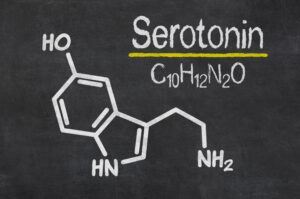
1. Tryptophan is onverted into 5-HTP
First, tryptophan is converted into 5-hydroxytryptophan with the help of an enzyme called tryptophan hydroxylase. This compound is often referred to by the abbreviation 5-HTP. This process is a key regulatory step in serotonin production.
2. 5-HTP is converted into serotonin
In the next step, 5-HTP is converted into serotonin by another enzyme, aromatic L-amino acid decarboxylase. For this, the body requires vitamin B6 in its active form as a coenzyme. This process demonstrates that serotonin production is a finely tuned biochemical process. Various precursors and enzymes must work together so that the body can produce the neurotransmitter.
The biochemical foundations of these conversion processes have been well studied. A review article on the dietary influences on the serotonergic system describes, in particular, the importance of tryptophan and various micronutrients for serotonin metabolism.
Tryptophan: Why Diet Matters
The amino acid tryptophan is not only important for serotonin production. It also serves as a precursor for melatonin, which plays a central role in regulating the sleep-wake cycle. Tryptophan is found in many everyday foods. Good sources include eggs, dairy products, fish, meat, legumes, nuts, seeds, and oatmeal.
A varied diet helps ensure the body receives this important amino acid. However, a particularly high intake of tryptophan does not automatically mean that the brain produces a correspondingly higher amount of serotonin. This is because the amino acid competes with other amino acids when crossing the blood-brain barrier. General metabolism and the activity of the enzymes involved also play a role. Therefore, it is not a single food that is decisive, but rather the interaction of various nutrients and metabolic processes.
Griffonia simplicifolia: An African Plant With Interesting Active Compounds
In addition to a diet rich in tryptophan-containing foods, there is also a plant that has garnered particular attention in connection with serotonin metabolism: Griffonia simplicifolia. The plant is native to West Africa and belongs to the legume family. It grows primarily in tropical regions and produces dark seeds that are distinguished by their unique composition.
What makes these seeds interesting is their natural content of 5-hydroxytryptophan (5-HTP). This compound is also an important intermediate step in the human body during the conversion of tryptophan to serotonin. This reveals an interesting connection between plant compounds and human metabolism. While the body can produce 5-HTP itself from tryptophan, the seeds of Griffonia simplicifolia naturally contain this compound.
The plant is therefore also the subject of scientific research. The focus is particularly on its constituents, the natural composition of the seeds, and their botanical properties. It is important to distinguish between the plant—or its seeds—and individual isolated substances. Origin, composition, and processing play a particularly important role when it comes to plant-based raw materials.
What is the Significance of B Vitamins for Metabolism?
Amino acids are not the only substances important for the body’s production of serotonin. Certain vitamins also play key roles in these biochemical processes. Vitamin B6 is particularly interesting. In its active form, it is needed as a coenzyme in the conversion of 5-HTP to serotonin. This means it is directly involved in a key step of the body’s serotonin production.
Vitamin B3, also known as niacin, fulfills numerous functions as well. It is a component of the coenzymes NAD and NADP, which are required for many reactions in energy metabolism. Both vitamins are among the important micronutrients the body needs for normal metabolism. A balanced diet helps meet daily requirements. However, it’s important to note that more is not automatically better. Consuming more than one’s individual needs does not necessarily lead to increased serotonin production.
The Gut and the Brain: What Science Is Discovering About Their Connection
It may come as a surprise that most of the body’s serotonin is produced in the gut. But it is precisely this fact that has fueled interest in the so-called gut-brain axis in recent years. This term refers to the two-way communication between the digestive system and the central nervous system. Involved in this exchange are, among other things, nerve pathways, hormones, immune messengers, and metabolic byproducts of gut bacteria.
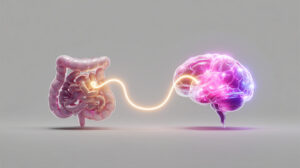
The gut microbiome—that is, the totality of microorganisms living in the gut—also plays an interesting role in this process. Certain gut bacteria can influence metabolic pathways associated with serotonin production in the intestinal mucosa. Researchers are increasingly investigating the significance of these interactions for digestion, metabolism, and possibly also mental well-being.
However, not all of these connections have been fully elucidated. In particular, one should not assume that a change in the gut flora automatically increases serotonin levels in the brain. Communication between the gut and the brain is much more complex.
What We Can Do Ourselves to Promote Our Well-Being
Even though the body’s own serotonin production cannot be easily controlled by a specific meal or a single nutrient, there are several ways to support the body in everyday life. Especially during the dark winter months, it’s worth paying attention to a few basic habits.
Make Conscious Use of Daylight
Try to go outside as regularly as possible—ideally in the morning. Even on cloudy days, natural daylight outdoors is usually much more intense than indoor lighting. It helps synchronize your internal clock with the natural day-night rhythm.
Incorporate exercise into your daily routine
A walk during your lunch break, a bike ride, or regular exercise in the fresh air can make a valuable contribution to your overall well-being. Physical activity influences numerous processes in the nervous system while also supporting physical health.
Make sure to eat a varied diet
Whole-grain products, vegetables, fruits, legumes, nuts, and high-quality protein sources provide important nutrients. These include tryptophan, which the body needs to produce serotonin.
Maintain a regular sleep schedule
Try to stick to consistent bedtimes and wake-up times as much as possible. A calm evening routine and reducing bright light late in the evening can also help support your natural sleep-wake cycle.
Don’t forget to take breaks and socialize
Well-being doesn’t depend solely on biochemical processes. Stress, personal pressures, and our social environment also influence how we feel. That’s why time for relaxation, shared activities, and enjoyable experiences should also have a place in our daily lives.
When Winter Fatigue is More than Just a Temporary Phase
Many people are familiar with a certain degree of fatigue and listlessness during the dark months. However, if your mood deteriorates significantly over a longer period, everyday activities become increasingly difficult, or your sleep and eating habits change drastically, you should take a closer look. Some people experience seasonal affective disorder, colloquially known as winter depression. This is a form of depression in which symptoms recur during specific seasons.
The causes are complex and cannot be attributed solely to low serotonin levels. Changes in the biological rhythm, genetic factors, and other biological and psychological influences may play a role. If symptoms are persistent or severe, it’s advisable to seek a medical evaluation. Light therapy can be an established treatment option for diagnosed seasonal depression.
Scientific research on serotonin demonstrates just how complex the connections are between the nervous system, digestion, and our daily rhythms. And it serves as a reminder that well-being does not depend on a single neurotransmitter. Rather, it arises from the interplay of numerous factors—and we can certainly have a positive influence on some of these through our daily habits.