




For decades, biology textbooks have taught that human hair grows because cells at the base of the hair follicle divide and push the hair shaft upward. However, new research suggests that this explanation is incomplete. Scientists have now found evidence that hair growth is driven by a hidden pulling force generated by moving cells inside the hair follicle.
This discovery challenges a long-held view of hair growth and could prompt researchers to rethink everything—from treatments for hair loss to regenerative medicine. The findings come from researchers at L’Oréal Research & Innovation and Queen Mary University of London and were published in the journal *Nature Communications *.
Inside the Hair Follicle
A hair follicle is a complex structure in the skin that forms and nourishes each individual hair. At the base of the follicle is the hair bulb, where cells divide rapidly to form new hair. Until now, scientists assumed that these newly formed cells acted like a conveyor belt, pushing older cells upward and thus ensuring that the hair grows out of the scalp.
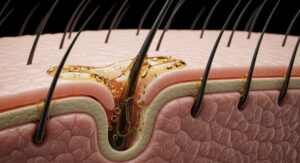
To investigate whether this explanation captures the full picture, the researchers used advanced 3D live-imaging technology to observe living human hair follicles maintained in a laboratory culture. Unlike conventional microscopy, which captures only still images, this approach allowed the scientists to track the movement and interaction of individual cells in real time.
The team focused on the outer root sheath, a layer of tissue that surrounds the growing hair shaft. Surprisingly, they observed that cells within this layer moved downward in a coordinated spiral pattern. Even more fascinating was that this movement occurred precisely in the area where the force that pulls the hair upward appeared to originate.
A Hidden Cellular Motor
Dr. Inês Sequeira, associate professor of oral and skin biology at Queen Mary and one of the study’s lead authors, said: “Our findings reveal a fascinating choreography inside the hair follicle. For decades, it was assumed that hair was pushed outward by dividing cells in the hair bulb. Instead, we found that it is actively pulled upward by surrounding tissue, which acts almost like a tiny motor.” The discovery suggests that hair growth depends not only on the formation of new cells but also on mechanical forces generated by the coordinated movement of cells within the follicle itself. This movement functions similarly to a tiny biological motor: instead of simply pushing the hair out from below, the surrounding tissue generates a pulling force that actively moves the hair shaft upward. In doing so, the hair follicle uses its own cellular movements to build a kind of mechanical growth system. The protein actin plays a key role in this process. This component of the cytoskeleton enables cells to change their shape, move, and exert forces on their surroundings. The coordinated activity of many individual cells creates a greater mechanical effect that supports the entire hair growth process.
This discovery challenges previous understandings of how biological structures grow. It demonstrates that growth is not controlled solely by cell production and chemical signals, but also by physical forces within the tissue. Such mechanical processes are becoming increasingly important in modern biology. Scientists are increasingly recognizing that cells not only influence their environment but also respond to mechanical signals. These interactions play an important role, for example, in organ development, wound healing, and tissue regeneration. This finding could be particularly significant for hair research. If the mechanical forces within the hair follicle are better understood, future therapies for hair loss could potentially not only influence cell division or hormonal processes but also specifically target the cells’ motility and force generation.
Monitoring Hair Growth in Real Time
To test their theory, the researchers conducted a series of experiments designed to distinguish the effects of cell division from those of cell movement. First, they blocked cell division inside the hair follicle. If the conventional explanation were entirely correct, hair growth should have slowed dramatically or come to a complete halt. Instead, the hair follicles continued to produce hair at nearly the same rate as before.

The team then turned its attention to actin, a protein found in cells throughout the body. Actin plays a crucial role in enabling cells to move, change shape, and generate force. When the researchers disrupted actin activity, the results were dramatic. Hair growth rates dropped by more than 80 percent, suggesting that cell movement and force generation are essential components of the growth process. Computer simulations corroborated these findings. The models showed that the coordinated movement of cells in the outer layers of the hair follicle generated tensile forces strong enough to explain the observed movement of the hair shaft.
Dr. Nicolas Tissot, the study’s first author from L’Oréal’s Advanced Research team, emphasized the importance of the new imaging technique: “We are using a novel imaging method that enables real-time 3D time-lapse microscopy. While static images provide only isolated snapshots, 3D time-lapse microscopy is indispensable for truly deciphering the complex, dynamic biological processes within the hair follicle and for revealing crucial cellular kinetics, migration patterns, and the rate of cell division—all of which cannot be inferred from individual observations. This approach made it possible to model the locally generated forces.” By tracking living cells over an extended period of time, the researchers were able to observe biological processes that would have remained hidden using conventional methods.
New Opportunities for Hair Loss Research
The study’s findings could have significant implications for our understanding of hair loss and the development of new therapies. Dr. Thomas Bornschlögl, another lead author from L’Oréal’s Advanced Research Team, explained: “This shows that hair growth is not driven solely by cell division—rather, the outer root sheath actively pulls the hair upward. This new perspective on the mechanics of hair follicles opens up new possibilities for researching hair disorders, testing medications, and advancing tissue engineering and regenerative medicine.”
Scientists are increasingly recognizing that biological tissues are shaped not only by genes and chemical signals, but also by physical forces. Understanding how these forces influence hair growth could help researchers develop future treatments that target both the biochemical environment of the hair follicle and its mechanical behavior. Although the experiments were conducted on human hair follicles grown in a laboratory culture—rather than directly on humans—the results provide valuable new insights into how hair follicles function. The researchers also believe that their imaging technique could become a powerful tool for evaluating potential therapies for hair loss, as it allows scientists to observe in real time how living follicles respond to various drugs and treatments.
A New Role for Biophysics in Everyday Biology
The study not only reveals new insights into hair growth but also underscores the growing importance of biophysics. This field of research investigates how physical forces influence biological processes in the body.
For a long time, biology focused primarily on genes and chemical signals. Today, however, scientists know that cells can also generate mechanical forces, move, and actively influence their environment. These processes play an important role in the development and regeneration of tissues. The hair follicle is an example of this: A seemingly simple process like hair growth is apparently based on a complex interplay of cell division, cell movement, and mechanical forces.
This discovery illustrates that even everyday biological processes are often more complex than they appear at first glance. The researchers hope that a better understanding of mechanical forces in tissues will help develop new methods for investigating and treating diseases in the future. Biophysics could thus play an important role in further unraveling the hidden mechanisms of the human body.