




Photoreceptor degeneration is one of the leading causes of severe visual impairment and blindness. Conditions that fall under this category include age-related macular degeneration (AMD) and retinitis pigmentosa (RP). Worldwide, an estimated 200 million people are affected by these diseases. In these conditions, the light-sensitive photoreceptors of the retina are gradually damaged and eventually die off. However, a large portion of the neural circuits located deeper within the retina can remain intact and functional. The problem is that, without photoreceptors, these surviving cells can no longer receive the light signals necessary to transmit visual information to the brain.
These remaining retinal circuits have become an important focus for scientists seeking to restore light sensitivity. Existing approaches include gene therapy, which is suitable only for a small proportion of patients with specific mutations, as well as electronic retinal prostheses, which can be invasive and costly and require extensive training. Optogenetics and light-sensitive drugs have also now entered clinical trials. Light-sensitive drugs have shown promising safety results, but restoring high-quality vision under normal lighting conditions remains challenging.
Light-Activated Drugs Offer a New Approach
A research consortium led by the Institute for Bioengineering of Catalonia (IBEC) has now developed a new class of light-switchable low-molecular-weight compounds designed to restore key visual functions in animal models of blindness. The findings were published in the Journal of the American Chemical Society (JACS).

The compounds are designed to take over some of the tasks normally performed by photoreceptors. Similar to other eye medications, they can be administered via injection into the eye or even applied as eye drops. Neither method requires genetic modification or an implanted device. The compounds have also demonstrated promising safety profiles, making them potential candidates for future therapies to restore vision.
“These molecules do not cure blindness, as they do not address the underlying cause of photoreceptor degeneration. But they are remarkably effective at restoring vision, and they do so using a very simple and potentially patient-friendly approach,” explained Pau Gorostiza, ICREA Research Professor at IBEC, head of the “Nanoprobes and Nanoswitches” group, member of CIBER-BBN, and co-lead author of the study. “Our goal was to restore vision using a molecular mechanism that comes as close as possible to the way a healthy retina functions,” said Rosalba Sortino, a former Ph.D. student at the University of Barcelona, currently a postdoctoral researcher in Gorostiza’s group at IBEC, and co-author of the study. “Instead of bypassing processing in the retina, we wanted to reactivate it at exactly the same level of the retinal circuit where the lost photoreceptor cells were located.” The results are based on more than ten years of research.
Restoring Visual Function in Blind Animals
The technique is based on photopharmacology, an approach that allows the effect of a drug to be reversibly controlled using light. The researchers modify the chemical structure of a drug by incorporating a light-sensitive molecular switch. When exposed to light, the switch alters the drug’s effect. Using this strategy, the team developed a family of compounds known as “Prosthe6.” These molecules target ON bipolar neurons and restored saccadic eye movements (the optokinetic reflex) in blind zebrafish larvae—a commonly used model for studying visual acuity.
The researchers also found that the treatment could restore the innate light-avoidance behavior in mouse models of age-related macular degeneration and retinitis pigmentosa. Healthy mice instinctively prefer darker environments and avoid brightly lit rooms. This behavior depends entirely on a functioning visual system. Blind mice lose this preference because they cannot perceive the difference between light and dark.
However, after being administered “prosthe6,” the blind mice once again spontaneously preferred dark areas. This behavior suggested that they could perceive light and use the visual information to control their behavior. No training was required. The effect also occurred at light levels typical of indoor environments or outdoors on a cloudy day. This suggests that the treatment restored functional light perception to such an extent that it elicited natural, visually guided behavior. Two compounds in particular, Prosthe6-12 and Prosthe6-15, yielded especially promising results. The restored visual behaviors occurred both after an injection into the eye and after topical administration in the form of eye drops.
Replacing the Function of Lost Photoreceptors
Prosthe6 specifically targets ON bipolar cells—retinal neurons that normally receive information from photoreceptors, the cells responsible for light perception. “In healthy vision, ON bipolar cells play a key role in relaying information about the presence of light to the rest of the visual circuit. In degenerative eye diseases, while the photoreceptors are lost, a large portion of these underlying circuits remains intact, albeit inactive. This presents a significant therapeutic opportunity,” explained de la Villa, one of the study’s lead authors.
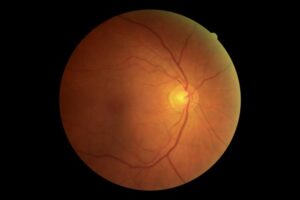
The connections target a protein (mGlu6) within these preserved retinal circuits. In this way, Prosthe6 can effectively replace some of the function normally performed by missing photoreceptors. When light hits the eye, the molecules change shape. This change triggers signaling processes in the retina that resemble the normal visual process. The researchers refer to the compounds as “molecular prostheses” because they enable the retina to respond to light again—without implanted devices or genetic modifications.
Another important feature is their ability to function under normal lighting conditions. Unlike some optogenetic approaches, they do not require devices that amplify or emit special light. The molecules are small and water-soluble and respond to ordinary visible or white light, including normal indoor lighting and daylight, without requiring unusually intense or specialized light sources.
On the Path to Potential Treatments in Humans
The findings come at a time when photopharmacology is increasingly making the transition from basic research toward clinical application. Shortly before this, a photopharmacological agent for restoring vision had been tested in a human clinical trial for the first time. However, that study involved a different active ingredient that targets a different protein. The new Prosthe6 technology, on the other hand, is still in preclinical development.
The technology is patent-protected. Researchers are currently working to further investigate the safety and formulation of the active ingredients and to extend the duration of restored visual function. Further studies are needed to determine whether the results from animal models can be transferred to humans and which form of administration is most suitable for this purpose. Clinical trials would then be necessary to investigate efficacy, dosage, and potential side effects.
According to the researchers, translating this into a therapy is a long and arduous process. Nevertheless, the results so far show that light-activated drugs could, in principle, be capable of replacing the function of lost photoreceptors at the molecular level. If the approach proves to be safe and effective in humans as well, it could eventually lead to a new, non-invasive treatment option for people with advanced retinal degeneration. Of particular interest is that the mechanism of action is not tied to a specific genetic mutation and could therefore potentially be applicable to various forms of retinal diseases. Until then, however, Prosthe6 remains an experimental approach. Whether the molecular prostheses can actually lead to a clinically relevant improvement in vision must first be demonstrated in further preclinical studies and ultimately in clinical trials with patients.